
CocoIndex
RustFS バケットに保存した文書を CocoIndex で埋め込みにインデックスする。
このガイドは、AI パイプライン向けの増分インデックスエンジン CocoIndex を、ドキュメントソースとして RustFS に接続します。バケットのプレフィックスから markdown ファイルを一覧し、チャンク化して埋め込みを生成し、Postgres に保存してインデックスをクエリするフローを構築します。このワークフローは CocoIndex 1.0.26 がカスタム S3 エンドポイント経由で RustFS バケットから読み取る形で検証しました。
Python 3.11 以上と、フローのターゲットおよび状態のための pgvector 拡張付き Postgres が必要です。
アーキテクチャ
CocoIndex は自分で作成する aiobotocore クライアント経由でソースオブジェクトを読むため、S3 互換エンドポイントなら何でも使えます。パススタイルアドレッシングの RustFS も例外ではありません。増分更新は内容が変わったファイルだけを再処理し、安定した S3 パスをキーにします。
環境を準備する
S3 コネクタ付きの CocoIndex と埋め込みスタックをインストールします:
python3 -m venv .venv
./.venv/bin/pip install torch --index-url https://download.pytorch.org/whl/cpu
./.venv/bin/pip install "cocoindex[amazon_s3]" asyncpg pgvector numpy python-dotenv sentence-transformers
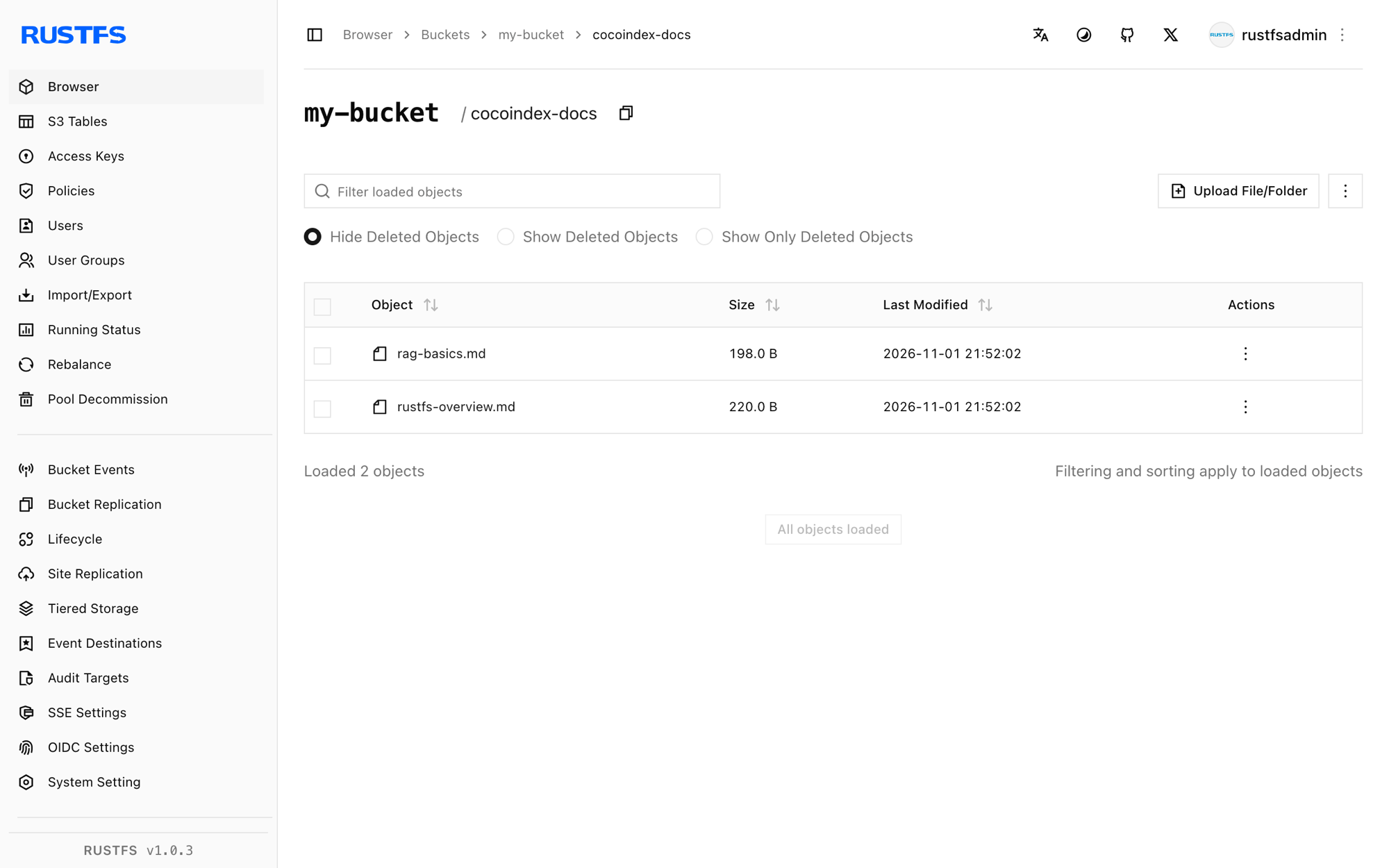
ソース文書をバケットのプレフィックスへアップロードします。接続プレースホルダーをすべて置き換えてください:
aws s3 cp ./docs s3://my-bucket/cocoindex-docs/ --recursive \
--endpoint-url http://<your-rustfs-endpoint>:9000upload: docs/rag-basics.md to s3://my-bucket/cocoindex-docs/rag-basics.md
upload: docs/rustfs-overview.md to s3://my-bucket/cocoindex-docs/rustfs-overview.mdフローを書く
環境ファイルとフローを作成します。S3 クライアントは AWS_ENDPOINT_URL を設定した状態で作成し、aiobotocore は S3 互換エンドポイントとしてこれを扱います:
S3_BUCKET=my-bucket
S3_PREFIX=cocoindex-docs/
AWS_ENDPOINT_URL=http://<your-rustfs-endpoint>:9000
AWS_ACCESS_KEY_ID=<your-access-key>
AWS_SECRET_ACCESS_KEY=<your-secret-key>
AWS_DEFAULT_REGION=us-east-1
COCOINDEX_DB=postgres://cocoindex:cocoindex@localhost:5432/cocoindex
POSTGRES_URL=postgres://cocoindex:cocoindex@localhost:5432/cocoindeximport asyncio, os, sys
from dataclasses import dataclass
from typing import AsyncIterator, Annotated
import aiobotocore.session
import asyncpg
from dotenv import load_dotenv
from numpy.typing import NDArray
from pgvector.asyncpg import register_vector
load_dotenv()
import cocoindex as coco
from cocoindex.connectors import amazon_s3, postgres
from cocoindex.ops.sentence_transformers import SentenceTransformerEmbedder
from cocoindex.ops.text import RecursiveSplitter
from cocoindex.resources.chunk import Chunk
from cocoindex.resources.file import PatternFilePathMatcher
DATABASE_URL = os.environ["POSTGRES_URL"]
TABLE_NAME = "rustfs_doc_embeddings"
PG_SCHEMA_NAME = "coco_examples"
S3_BUCKET = os.environ["S3_BUCKET"]
S3_PREFIX = os.getenv("S3_PREFIX", "")
EMBED_MODEL = "sentence-transformers/all-MiniLM-L6-v2"
PG_DB = coco.ContextKey[asyncpg.Pool]("db")
S3_CLIENT = coco.ContextKey[object]("s3_client")
EMBEDDER = coco.ContextKey[SentenceTransformerEmbedder]("embedder", detect_change=True)
_splitter = RecursiveSplitter()
@coco.lifespan
async def coco_lifespan(builder: coco.EnvironmentBuilder) -> AsyncIterator[None]:
async with asyncpg.create_pool(DATABASE_URL, init=register_vector) as pool:
builder.provide(PG_DB, pool)
builder.provide(EMBEDDER, SentenceTransformerEmbedder(EMBED_MODEL))
session = aiobotocore.session.get_session()
async with session.create_client("s3") as s3_client:
builder.provide(S3_CLIENT, s3_client)
yield
@dataclass
class DocEmbedding:
id: int
filename: str
text: str
embedding: Annotated[NDArray, EMBEDDER]
@coco.fn
async def process_chunk(chunk: Chunk, filename: str, table: postgres.TableTarget[DocEmbedding]) -> None:
table.declare_row(row=DocEmbedding(
id=abs(hash(f"{filename}:{chunk.start.char_offset}")) % (10 ** 9),
filename=filename, text=chunk.text,
embedding=await coco.use_context(EMBEDDER).embed(chunk.text),
))
@coco.fn(memo=True)
async def process_file(file: amazon_s3.S3File, table: postgres.TableTarget[DocEmbedding]) -> None:
text = await file.read_text()
chunks = _splitter.split(text, chunk_size=2000, chunk_overlap=500, language="markdown")
await coco.map(process_chunk, chunks, file.file_path.path.as_posix(), table)
@coco.fn
async def app_main() -> None:
target_table = await postgres.mount_table_target(
PG_DB, table_name=TABLE_NAME,
table_schema=await postgres.TableSchema.from_class(DocEmbedding, primary_key=["id"]),
pg_schema_name=PG_SCHEMA_NAME,
)
client = coco.use_context(S3_CLIENT)
files = amazon_s3.list_objects(client, S3_BUCKET, prefix=S3_PREFIX,
path_matcher=PatternFilePathMatcher(included_patterns=["**/*.md"]))
await coco.mount_each(process_file, files.items(), target_table)
app = coco.App(coco.AppConfig(name="RustFSDocs"), app_main)
TOP_K = 5
async def query_once(
pool: asyncpg.Pool,
embedder: SentenceTransformerEmbedder,
query: str,
*,
top_k: int = TOP_K,
) -> None:
query_vec = await embedder.embed(query)
async with pool.acquire() as conn:
rows = await conn.fetch(
f"""
SELECT filename, text, embedding <=> $1 AS distance
FROM "{PG_SCHEMA_NAME}"."{TABLE_NAME}"
ORDER BY distance ASC
LIMIT $2
""",
query_vec,
top_k,
)
for r in rows:
score = 1.0 - float(r["distance"])
print(f"[{score:.3f}] {r['filename']}")
print(f" {r['text']}")
print("---")
async def query(initial_query: str | None = None) -> None:
embedder = SentenceTransformerEmbedder(EMBED_MODEL)
async with asyncpg.create_pool(DATABASE_URL, init=register_vector) as pool:
if initial_query is not None:
await query_once(pool, embedder, initial_query)
return
while True:
q = input("Enter search query (or Enter to quit): ").strip()
if not q:
break
await query_once(pool, embedder, q)
if __name__ == "__main__":
initial = " ".join(sys.argv[1:]) if len(sys.argv) > 1 else None
asyncio.run(query(initial))RustFS からインデックスを構築する
set -a && . ./.env && set +a
./.venv/bin/cocoindex update main✅ app_main: 1 total | 1 added
✅ process_file: 2 total | 2 added2 つの markdown ファイルが RustFS バケットから読み込まれ、チャンク化されて Postgres に埋め込まれました。main.py のエントリポイントでインデックスを検索します。スクリプトは .env を読み込み、同じモデルで質問の埋め込みを計算し、最も近いチャンクを表示します:
./.venv/bin/python main.py "what does RustFS expose"[0.163] rag-basics.md
Retrieval augmented generation combines a retriever and a generator.
---クエリがヒットするチャンクの正本(source of truth)はバケットです。RustFS 内のファイルを編集して cocoindex update main を再実行すれば、変更部分だけが増分で再インデックスされます。
停止またはリセット
インデックス済みの文書を削除するには:
aws s3 rm s3://my-bucket/cocoindex-docs --recursive \
  --endpoint-url http://<your-rustfs-endpoint>:9000
トラブルシューティング
Environment settings must provide Settings.db_path
CocoIndex は自身の状態も Postgres に保持します。COCOINDEX_DB(ターゲットには POSTGRES_URL)を、pgvector 拡張が有効なデータベースに向けてください。
フローからの InvalidAccessKeyId や接続タイムアウト
フロー実行前に環境変数がエクスポートされていません(set -a && . ./.env && set +a)。AWS_ENDPOINT_URL にはスキーマが必須で、認証情報は標準の AWS_ACCESS_KEY_ID/AWS_SECRET_ACCESS_KEY のペアで渡します。
フローがファイルを 1 つも見つけられない
プレフィックスとマッチャーを確認してください。list_objects は S3_PREFIX を走査し、included_patterns で絞り込みます。aws s3 ls s3://my-bucket/cocoindex-docs/ でオブジェクトの存在を確認してください。
次のステップ
- 追加のソースを接続する前に S3 互換性についての注意 を確認してください。
- アクセスキー管理 で本番用の専用認証情報を作成してください。
- CocoIndex Amazon S3 コネクタのドキュメント に従い、パスマッチャー・サイズ制限・ライブ更新を活用してください。