
CocoIndex
用 CocoIndex 把存放在 RustFS 桶中的文档索引成向量。
本指南将面向 AI 管道的增量索引引擎 CocoIndex 连接到 RustFS 作为文档源。你将构建一个流:从桶前缀列出 markdown 文件、分块并向量化、把向量存进 Postgres,最后查询索引。整个流程使用 CocoIndex 1.0.26 通过自定义 S3 端点从 RustFS 桶读取验证通过。
你需要 Python 3.11+ 和带 pgvector 扩展的 Postgres(流的与状态存储)。
架构
CocoIndex 通过你自建的 aiobotocore 客户端读取源对象,因此任何 S3 兼容端点都能用——包括路径样式寻址的 RustFS。增量更新只处理内容变化的文件,以稳定的 S3 路径为键。
准备环境
安装带 S3 连接器的 CocoIndex 和 embedding 栈:
python3 -m venv .venv
./.venv/bin/pip install torch --index-url https://download.pytorch.org/whl/cpu
./.venv/bin/pip install "cocoindex[amazon_s3]" asyncpg pgvector numpy python-dotenv sentence-transformers
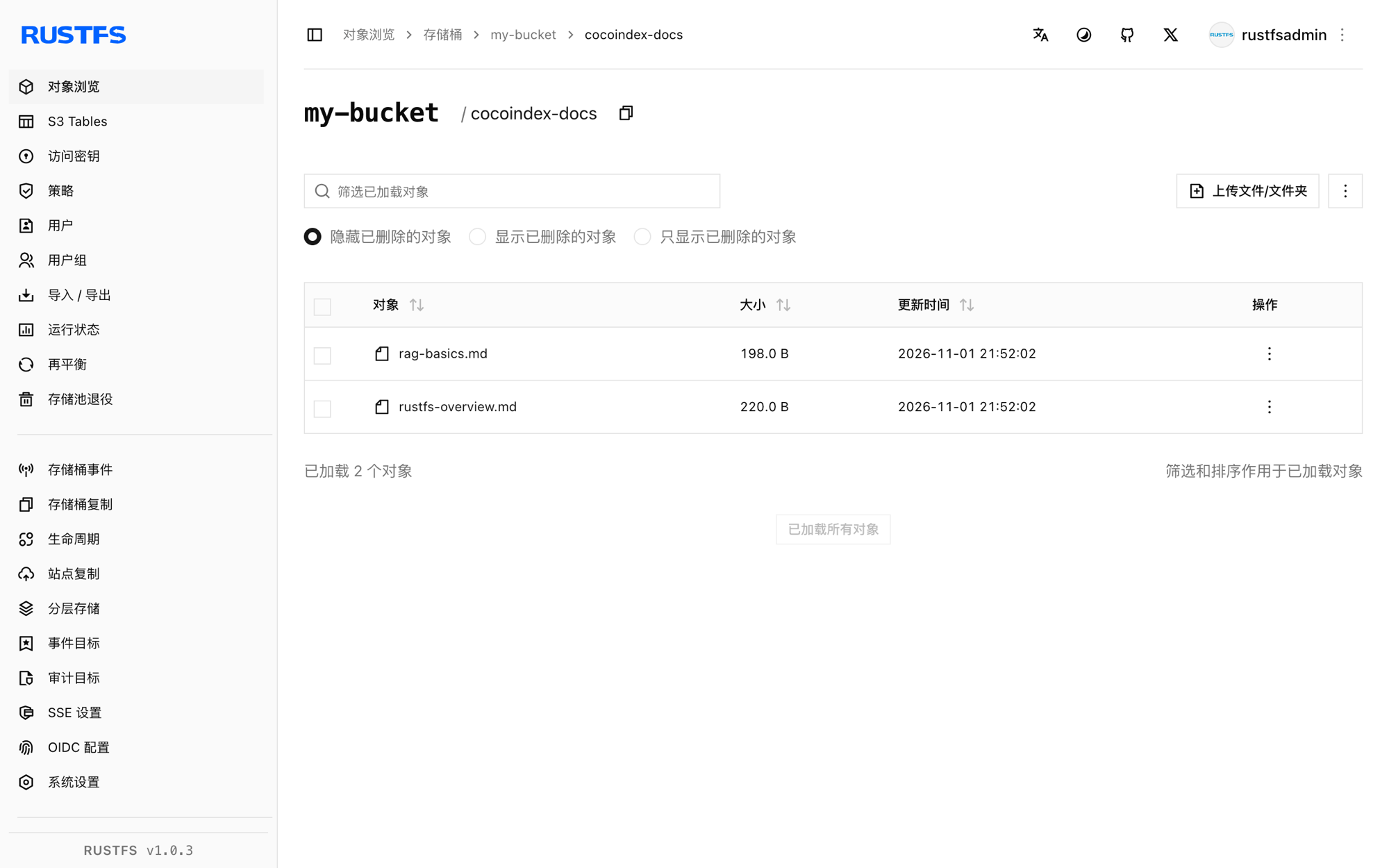
把源文档上传到桶前缀,替换全部连接占位符:
aws s3 cp ./docs s3://my-bucket/cocoindex-docs/ --recursive \
--endpoint-url http://<your-rustfs-endpoint>:9000upload: docs/rag-basics.md to s3://my-bucket/cocoindex-docs/rag-basics.md
upload: docs/rustfs-overview.md to s3://my-bucket/cocoindex-docs/rustfs-overview.md编写流
创建环境文件和流。S3 客户端在 AWS_ENDPOINT_URL 已设置时创建,aiobotocore 会据此指向 S3 兼容端点:
S3_BUCKET=my-bucket
S3_PREFIX=cocoindex-docs/
AWS_ENDPOINT_URL=http://<your-rustfs-endpoint>:9000
AWS_ACCESS_KEY_ID=<your-access-key>
AWS_SECRET_ACCESS_KEY=<your-secret-key>
AWS_DEFAULT_REGION=us-east-1
COCOINDEX_DB=postgres://cocoindex:cocoindex@localhost:5432/cocoindex
POSTGRES_URL=postgres://cocoindex:cocoindex@localhost:5432/cocoindeximport asyncio, os, sys
from dataclasses import dataclass
from typing import AsyncIterator, Annotated
import aiobotocore.session
import asyncpg
from dotenv import load_dotenv
from numpy.typing import NDArray
from pgvector.asyncpg import register_vector
load_dotenv()
import cocoindex as coco
from cocoindex.connectors import amazon_s3, postgres
from cocoindex.ops.sentence_transformers import SentenceTransformerEmbedder
from cocoindex.ops.text import RecursiveSplitter
from cocoindex.resources.chunk import Chunk
from cocoindex.resources.file import PatternFilePathMatcher
DATABASE_URL = os.environ["POSTGRES_URL"]
TABLE_NAME = "rustfs_doc_embeddings"
PG_SCHEMA_NAME = "coco_examples"
S3_BUCKET = os.environ["S3_BUCKET"]
S3_PREFIX = os.getenv("S3_PREFIX", "")
EMBED_MODEL = "sentence-transformers/all-MiniLM-L6-v2"
PG_DB = coco.ContextKey[asyncpg.Pool]("db")
S3_CLIENT = coco.ContextKey[object]("s3_client")
EMBEDDER = coco.ContextKey[SentenceTransformerEmbedder]("embedder", detect_change=True)
_splitter = RecursiveSplitter()
@coco.lifespan
async def coco_lifespan(builder: coco.EnvironmentBuilder) -> AsyncIterator[None]:
async with asyncpg.create_pool(DATABASE_URL, init=register_vector) as pool:
builder.provide(PG_DB, pool)
builder.provide(EMBEDDER, SentenceTransformerEmbedder(EMBED_MODEL))
session = aiobotocore.session.get_session()
async with session.create_client("s3") as s3_client:
builder.provide(S3_CLIENT, s3_client)
yield
@dataclass
class DocEmbedding:
id: int
filename: str
text: str
embedding: Annotated[NDArray, EMBEDDER]
@coco.fn
async def process_chunk(chunk: Chunk, filename: str, table: postgres.TableTarget[DocEmbedding]) -> None:
table.declare_row(row=DocEmbedding(
id=abs(hash(f"{filename}:{chunk.start.char_offset}")) % (10 ** 9),
filename=filename, text=chunk.text,
embedding=await coco.use_context(EMBEDDER).embed(chunk.text),
))
@coco.fn(memo=True)
async def process_file(file: amazon_s3.S3File, table: postgres.TableTarget[DocEmbedding]) -> None:
text = await file.read_text()
chunks = _splitter.split(text, chunk_size=2000, chunk_overlap=500, language="markdown")
await coco.map(process_chunk, chunks, file.file_path.path.as_posix(), table)
@coco.fn
async def app_main() -> None:
target_table = await postgres.mount_table_target(
PG_DB, table_name=TABLE_NAME,
table_schema=await postgres.TableSchema.from_class(DocEmbedding, primary_key=["id"]),
pg_schema_name=PG_SCHEMA_NAME,
)
client = coco.use_context(S3_CLIENT)
files = amazon_s3.list_objects(client, S3_BUCKET, prefix=S3_PREFIX,
path_matcher=PatternFilePathMatcher(included_patterns=["**/*.md"]))
await coco.mount_each(process_file, files.items(), target_table)
app = coco.App(coco.AppConfig(name="RustFSDocs"), app_main)
TOP_K = 5
async def query_once(
pool: asyncpg.Pool,
embedder: SentenceTransformerEmbedder,
query: str,
*,
top_k: int = TOP_K,
) -> None:
query_vec = await embedder.embed(query)
async with pool.acquire() as conn:
rows = await conn.fetch(
f"""
SELECT filename, text, embedding <=> $1 AS distance
FROM "{PG_SCHEMA_NAME}"."{TABLE_NAME}"
ORDER BY distance ASC
LIMIT $2
""",
query_vec,
top_k,
)
for r in rows:
score = 1.0 - float(r["distance"])
print(f"[{score:.3f}] {r['filename']}")
print(f" {r['text']}")
print("---")
async def query(initial_query: str | None = None) -> None:
embedder = SentenceTransformerEmbedder(EMBED_MODEL)
async with asyncpg.create_pool(DATABASE_URL, init=register_vector) as pool:
if initial_query is not None:
await query_once(pool, embedder, initial_query)
return
while True:
q = input("Enter search query (or Enter to quit): ").strip()
if not q:
break
await query_once(pool, embedder, q)
if __name__ == "__main__":
initial = " ".join(sys.argv[1:]) if len(sys.argv) > 1 else None
asyncio.run(query(initial))从 RustFS 构建索引
set -a && . ./.env && set +a
./.venv/bin/cocoindex update main✅ app_main: 1 total | 1 added
✅ process_file: 2 total | 2 added两个 markdown 文件都从 RustFS 桶读出、分块并向量化进 Postgres。用 main.py 的入口查询索引。脚本会加载 .env,用同一模型计算问题的嵌入,并打印最近的 chunk:
./.venv/bin/python main.py "what does RustFS expose"[0.163] rag-basics.md
Retrieval augmented generation combines a retriever and a generator.
---查询命中的 chunk 以桶为事实来源——在 RustFS 里编辑文件后重跑 cocoindex update main,只会增量重建变化的部分。
停止或重置
删除已索引的文档:
aws s3 rm s3://my-bucket/cocoindex-docs --recursive \
  --endpoint-url http://<your-rustfs-endpoint>:9000
故障排查
Environment settings must provide Settings.db_path
CocoIndex 自己的状态也存 Postgres。把 COCOINDEX_DB(目标表用 POSTGRES_URL)指向启用了 pgvector 扩展的数据库。
流报 InvalidAccessKeyId 或连接超时
运行流之前没有导出环境变量(set -a && . ./.env && set +a)。AWS_ENDPOINT_URL 必须带协议;凭证走标准 AWS_ACCESS_KEY_ID/AWS_SECRET_ACCESS_KEY。
流看不到文件
检查前缀与匹配器——list_objects 遍历 S3_PREFIX 并按 included_patterns 过滤。先用 aws s3 ls s3://my-bucket/cocoindex-docs/ 确认对象存在。
下一步
- 在接入更多源之前,先阅读 S3 兼容性说明。
- 使用访问密钥管理创建专用的生产凭证。
- 按照 CocoIndex Amazon S3 连接器文档使用路径匹配器、大小限制与实时更新。