
SGLang
Serve LLM inference with SGLang streaming model weights directly from a RustFS bucket.
This guide connects SGLang — the serving framework for large language models and multimodal models — to RustFS as its model-weight store. You will upload a model into a RustFS bucket, point SGLang at the s3:// URI, and serve OpenAI-compatible requests with the weights streamed straight from the bucket. The workflow was verified with lmsysorg/sglang:v0.5.22-xeon (SGLang 0.5.22, CPU engine) serving Qwen/Qwen2.5-0.5B-Instruct from a RustFS bucket on a CPU-only host.
You need Docker and a small Hugging Face model. This deployment is intended for local integration testing, not production.
Architecture
When --model-path is an object-storage URI, SGLang switches to its runai_streamer load format automatically: the metadata files (config.json, tokenizer) download once into the local cache, then weight tensors stream lazily while the engine loads. The bucket stays the single copy of the model, so serving hosts need no local model store.
The CPU image ships without the S3 streamer
The xeon CPU image does not include runai-model-streamer-s3, and starting the server with an s3:// model path fails with ImportError: S3 files module not found. Install the package inside the container before launching the server — the image's virtual environment is managed with uv, which has no pip module.
Upload the model to RustFS
Fetch the model files from Hugging Face and copy them into the bucket, replacing all connection placeholders:
docker run --rm -v "$PWD/models:/models" --entrypoint python3 \
  lmsysorg/sglang:v0.5.22-xeon -c \
  'from huggingface_hub import snapshot_download; snapshot_download("Qwen/Qwen2.5-0.5B-Instruct", local_dir="/models/qwen2.5-0.5b-instruct")'

aws s3 cp models/qwen2.5-0.5b-instruct \
  s3://my-bucket/sglang-models/qwen2.5-0.5b-instruct --recursive \
  --endpoint-url http://<your-rustfs-endpoint>:9000 \
  --acl private
Export the credentials for the following commands:
export AWS_ACCESS_KEY_ID=<your-access-key>
export AWS_SECRET_ACCESS_KEY=<your-secret-key>
export AWS_DEFAULT_REGION=us-east-1
Keep one model per prefix so several models can share the bucket. The streamer reads weight files in .safetensors format only.
Start SGLang against the bucket
Run the CPU image, install the S3 streamer package, and launch the server against the bucket URI:
docker run -d --name sglang -p 30000:30000 \
  -e AWS_ACCESS_KEY_ID \
  -e AWS_SECRET_ACCESS_KEY \
  -e AWS_DEFAULT_REGION \
  -e AWS_ENDPOINT_URL=http://<your-rustfs-endpoint>:9000 \
  --entrypoint bash lmsysorg/sglang:v0.5.22-xeon -c \
  'uv pip install -q runai-model-streamer-s3 && \
   python3 -m sglang.launch_server \
     --model-path s3://my-bucket/sglang-models/qwen2.5-0.5b-instruct \
     --served-model-name qwen2.5-0.5b-instruct \
     --host 0.0.0.0 --port 30000 \
     --device cpu --trust-remote-code \
     --disable-overlap-schedule \
     --mem-fraction-static 0.45'
AWS_ENDPOINT_URL points the streamer at RustFS; requests use path-style addressing against the custom endpoint. --mem-fraction-static sizes the KV cache share of host memory on the CPU backend — raise it on hosts with more free RAM. Wait for the startup line:
docker logs -f sglangThe server is fired up and ready to roll!Run inference
Confirm the model is served, then send an OpenAI-compatible completion request:
curl -s http://localhost:30000/v1/models{"object":"list","data":[{"id":"qwen2.5-0.5b-instruct","object":"model","owned_by":"sglang","root":"qwen2.5-0.5b-instruct","max_model_len":32768}]}curl -s http://localhost:30000/v1/completions \
-H "Content-Type: application/json" \
-d '{"model":"qwen2.5-0.5b-instruct","prompt":"RustFS is","max_tokens":16,"temperature":0}'{"object":"text_completion","model":"qwen2.5-0.5b-instruct","choices":[{"index":0,"text":" a file system for the Linux kernel that is designed to be used in embedded systems","finish_reason":"length"}],"usage":{"prompt_tokens":4,"total_tokens":20,"completion_tokens":16}}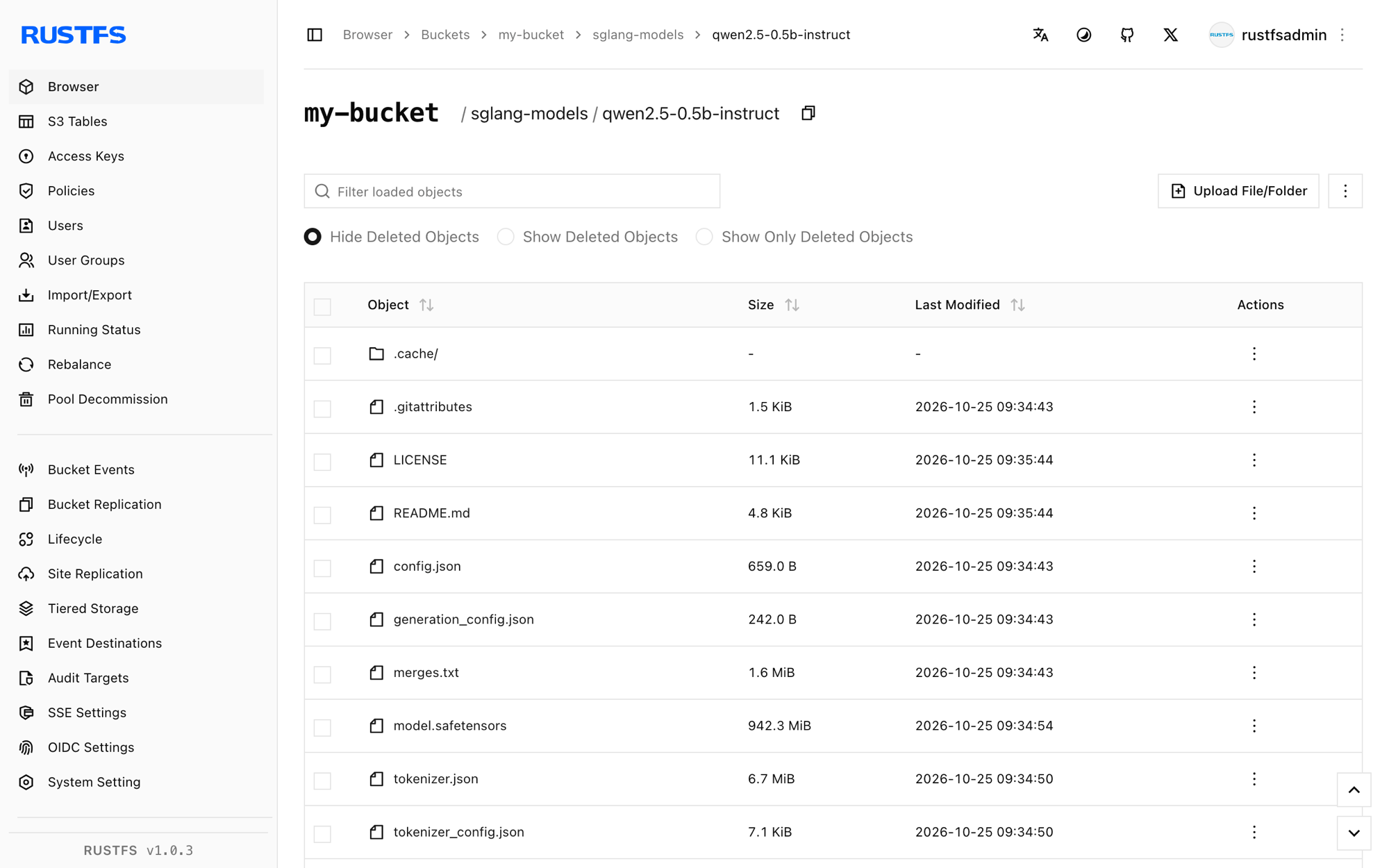
Stop or reset
To tear down the demo while keeping the bucket objects:
docker rm -f sglangTo delete the stored model:
aws s3 rm s3://my-bucket/sglang-models --recursive \
  --endpoint-url http://<your-rustfs-endpoint>:9000
Troubleshooting
ImportError: S3 files module not found
The S3 backend of the runai streamer is missing. Run uv pip install runai-model-streamer-s3 inside the container before starting the server, as shown in step 2.
pip: command not found or No module named pip
The image's /opt/.venv is created by uv without pip. Use uv pip install instead of pip install.
Loaded weights leave no GPU memory for the KV cache
--mem-fraction-static is too small for the loaded weights on this host. The error message reports the minimum viable value — restart the server with a larger fraction (for example 0.45 on a 16 GB host for a 0.5 B model).
Requests fail with signature or access errors
Confirm all four variables are set for the server container: AWS_ACCESS_KEY_ID, AWS_SECRET_ACCESS_KEY, AWS_DEFAULT_REGION, and AWS_ENDPOINT_URL including the scheme.
Next steps
- Review S3 compatibility notes before adopting additional serving operations.
- Create dedicated production credentials with Access Key Management.
- Follow the SGLang documentation for tensor parallelism, quantization, and larger models on the same bucket-backed model store.