
RustFS Single Node Multiple Disk Installation
Install RustFS on a single server with multiple disks, data will be stored on multiple disks.
In Single Node Multiple Disk (SNMD) mode, one server stores data in sharded form across multiple data disks. Each object is split into K data shards and M parity shards (erasure coding), so the loss of up to M disks does not cause data loss.
SNMD is suitable for medium, non-critical business. Damage to at most M disks does not pose a data risk, but if the entire server fails or more than M disks are damaged, data will be lost. Keep backups of important data. For node-level fault tolerance, use MNMD.
Topology and Planning
- 1 server with multiple data disks (this example uses 4 disks mounted at
/data/rustfs0through/data/rustfs3). - Erasure coding spreads data and parity shards across the disks; fault tolerance is limited to disk failures within the single node.
- Format each disk with XFS and mount it separately (e.g., labels
RUSTFS0–RUSTFS3), as described in the prerequisites page. - For production deployments, also review the Pre-Installation Checklists.
Prerequisites and Service Setup
Complete the common prerequisites and service setup — operating system, firewall, time synchronization, disk formatting, service user, binary download, and systemd unit — then continue below.
Configure Environment Variables
- Create the configuration file.
RUSTFS_VOLUMESuses brace expansion to enumerate the four disk mount points:
# Use a unique access key and a strong, random secret (e.g. openssl rand -base64 24)
RUSTFS_ACCESS_KEY=<your-access-key>
RUSTFS_SECRET_KEY=<your-secret-key>
RUSTFS_VOLUMES="/data/rustfs{0...3}"
RUSTFS_ADDRESS=":9000"
RUSTFS_CONSOLE_ENABLE=true
RUSTFS_CONSOLE_ADDRESS=":9001"
RUSTFS_OBS_LOGGER_LEVEL=error
RUSTFS_OBS_LOG_DIRECTORY="/var/log/rustfs/"- Create the storage and log directories:
sudo mkdir -p /data/rustfs{0..3} /var/log/rustfs /opt/tls
sudo chmod -R 750 /data/rustfs* /var/log/rustfs
Start Service and Verification
- Start the service and enable auto-start on boot:
sudo systemctl enable --now rustfs- Verify the service status:
systemctl status rustfs- Check the service port:
netstat -ntpl- View log files:
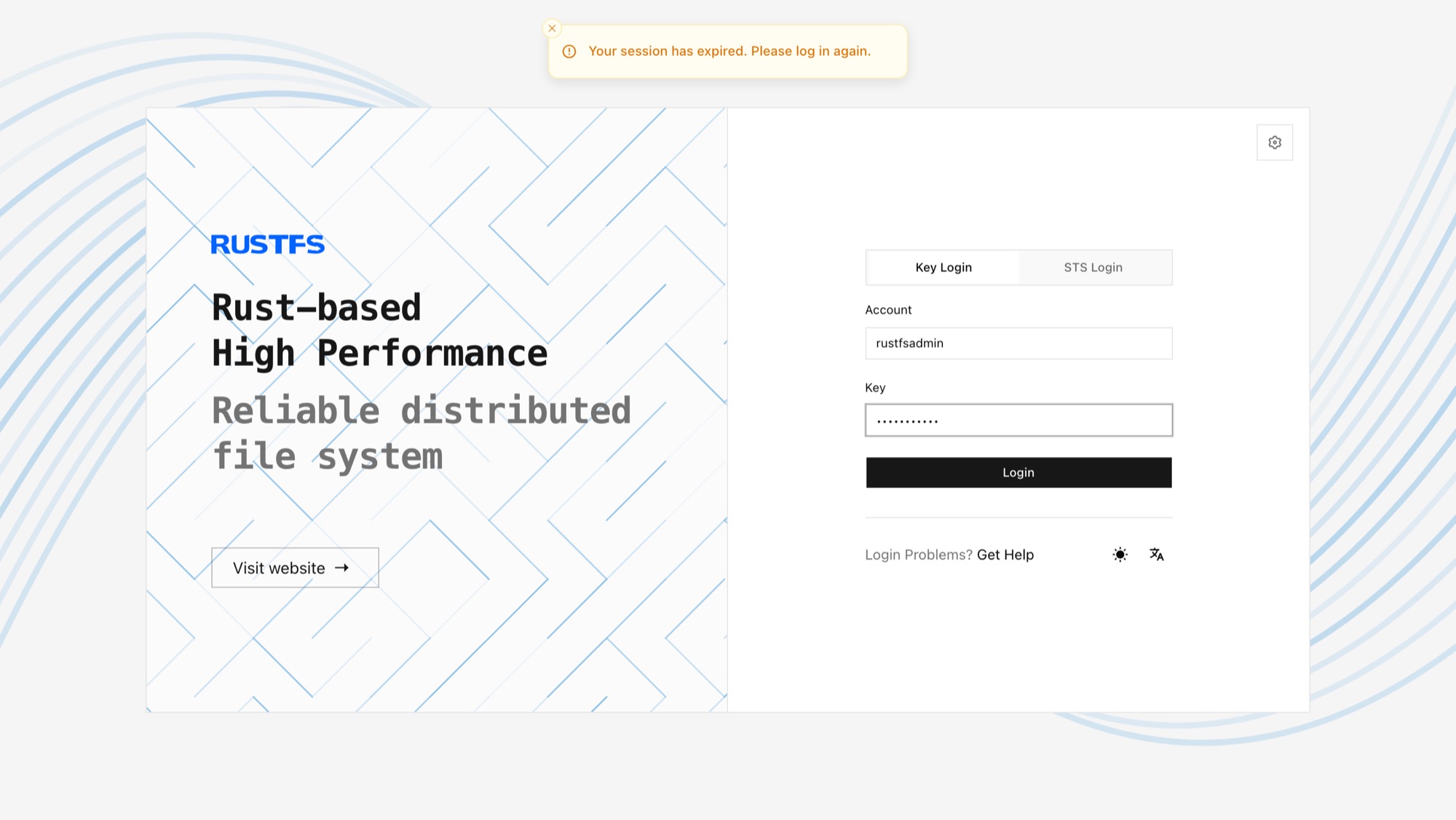
tail -f /var/log/rustfs/rustfs*.log- Access the console: enter the server's IP address and the console port (default 9001) in a browser. You should see:
Next Steps
- Need node-level fault tolerance and horizontal scalability? See Multiple Node Multiple Disk Mode (MNMD).
- Just experimenting? Single Node Single Disk Mode (SNSD) is simpler to set up.