
Apache Camel
Route data in and out of a RustFS bucket with Apache Camel integration routes.
This guide connects Apache Camel — the versatile integration framework — to RustFS through its S3 component. You will write a two-route integration in YAML: a producer route that writes a message to a bucket on a timer, and a consumer route that reads those objects back and logs them. The workflow was verified with Camel JBang on eclipse-temurin:21-jdk, using the aws2-s3 component with an overridden endpoint and path-style addressing.
You need Docker. This deployment is intended for local integration testing, not production.
Architecture
Camel JBang runs the route file directly and resolves the S3 component dependencies automatically — no project scaffolding, build, or deploy step.
Write the integration route
Create the route file. Credentials come from the default AWS provider chain (environment variables), so the URIs carry only addressing:
- from:
    uri: "timer:tick"
    parameters:
      period: "5000"
    steps:
      - setBody:
          simple: "Hello from Camel at ${date:now:yyyy-MM-dd HH:mm:ss}"
      - setHeader:
          name: "CamelAwsS3Key"
          simple: "camel/hello-${date:now:HHmmss}.txt"
      - to:
          uri: "aws2-s3://my-bucket?overrideEndpoint=true&uriEndpointOverride=http://<your-rustfs-endpoint>:9000&forcePathStyle=true&useDefaultCredentialsProvider=true"
- from:
    uri: "aws2-s3://my-bucket?prefix=camel/&deleteAfterRead=false&maxMessagesPerPoll=5&overrideEndpoint=true&uriEndpointOverride=http://<your-rustfs-endpoint>:9000&forcePathStyle=true&useDefaultCredentialsProvider=true"
    steps:
      - to:
          uri: "log:from-rustfs"
The producer sets the object key through the CamelAwsS3Key header — here a per-message timestamp, so every tick writes a new object. The consumer polls the camel/ prefix with deleteAfterRead=false, so objects stay in the bucket after they are consumed.
Component name and endpoint options
The component resolved by Camel JBang in this workflow is aws2-s3. overrideEndpoint=true activates the custom endpoint, uriEndpointOverride carries its URL, and forcePathStyle=true selects the path-style addressing RustFS expects. useDefaultCredentialsProvider=true makes the component read credentials from the standard environment variables.
Run the route with Camel JBang
Run the integration in a container with the credentials exported. JBang asks to trust the sources on first use, so add the trust rules before starting:
docker run --rm --network bridge \
  -e AWS_ACCESS_KEY_ID=<your-access-key> \
  -e AWS_SECRET_ACCESS_KEY=<your-secret-key> \
  -e AWS_REGION=us-east-1 \
  -v "$PWD:/routes" \
  --entrypoint bash eclipse-temurin:21-jdk -c '
    export JBANG_DIR=/root/.jbang PATH=/root/.jbang/bin:$PATH
    curl -Ls https://sh.jbang.dev | bash >/dev/null 2>&1
    jbang trust add https://github.com/apache/ 2>/dev/null || true
    jbang trust add /routes 2>/dev/null || true
    cd /routes && jbang camel@apache/camel run route.yaml
  '
The first run downloads the Camel runtime and dependencies, then starts the routes. Consumers log each object they read:
2026-10-25 02:02:41.069 INFO 120 --- [-s3://my-bucket] from-rustfs : Exchange[ExchangePattern: InOnly, BodyType: byte[], Body: Hello from Camel at 2026-10-25 02:02:38]Verify the objects
Confirm the producer's objects sit in RustFS, replacing all connection placeholders:
aws s3 ls s3://my-bucket/camel/ \
--endpoint-url http://<your-rustfs-endpoint>:90002026-10-25 02:02:13 39 hello-020213.txt
2026-10-25 02:02:18 39 hello-020218.txt
2026-10-25 02:02:23 39 hello-020223.txt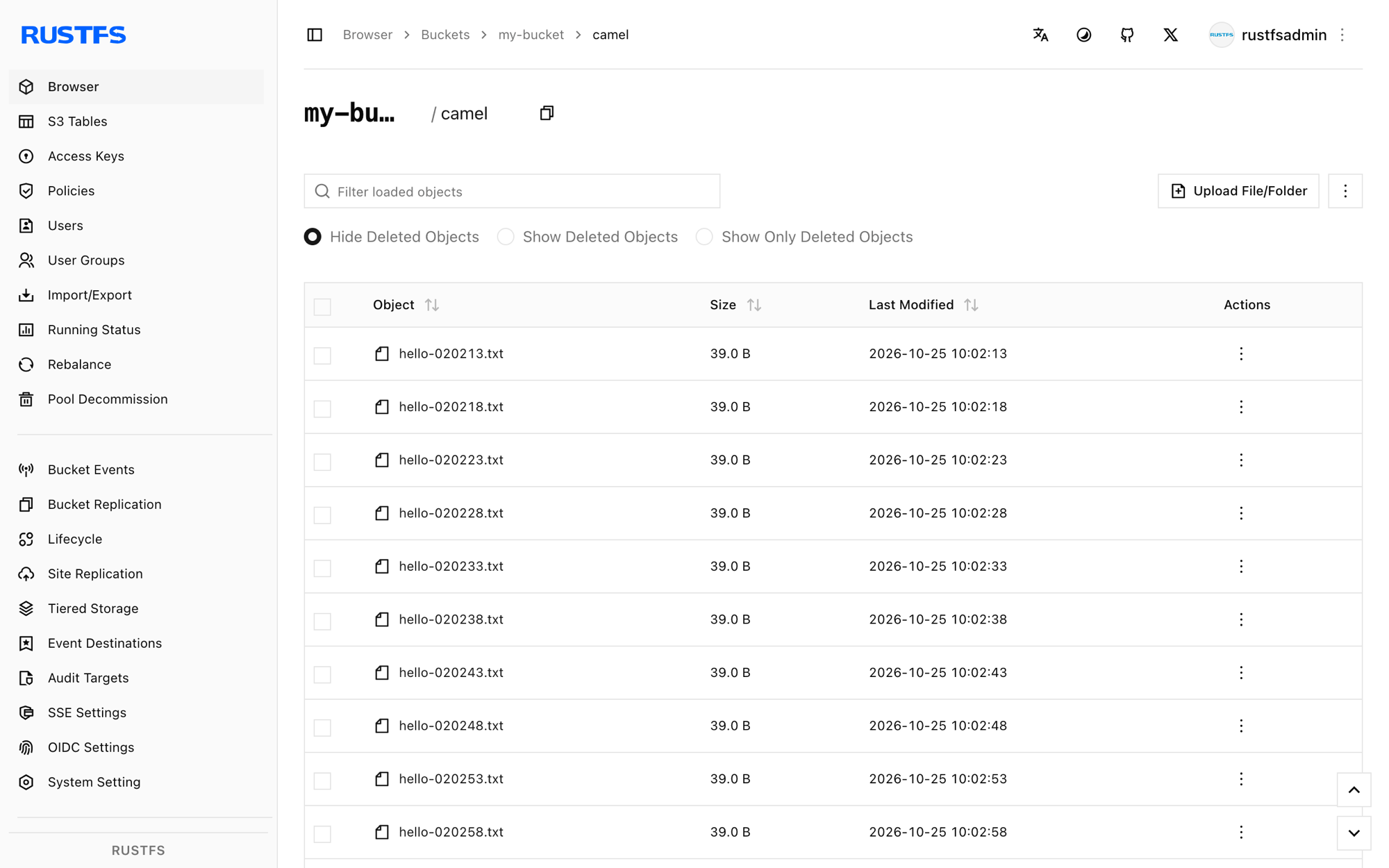
Stop or reset
Stop the container to end the routes. To delete the demo objects:
aws s3 rm s3://my-bucket/camel --recursive \
  --endpoint-url http://<your-rustfs-endpoint>:9000
Troubleshooting
Cannot find component with name: aws-s3
Your Camel version resolves the component under a different name — this workflow runs against aws2-s3. Use the name your runtime reports in the suggestion list (Did you mean: ... aws2-s3 ...).
is not from a trusted source
JBang refuses to run untrusted code. Run jbang trust add https://github.com/apache/ and jbang trust add /routes before jbang camel@apache/camel run, as shown in step 2.
useDefaultCredentialsProvider is set to false
The component found no credential configuration in the URI. Either add useDefaultCredentialsProvider=true and export AWS_ACCESS_KEY_ID and AWS_SECRET_ACCESS_KEY, or configure the accessKey and secretKey endpoint options directly.
Consumer reads nothing
The consumer only polls the prefix given by prefix=camel/. Confirm the producer ran (timer log lines appear) and that its CamelAwsS3Key header starts with camel/.
Next steps
- Review S3 compatibility notes before adopting multipart or streaming operations on this component.
- Create dedicated production credentials with Access Key Management.
- Follow the Camel S3 component documentation for download ranges, bucket operations, and consumer tuning on the same routes.