
CocoIndex
Index documents stored in a RustFS bucket into embeddings with CocoIndex.
This guide connects CocoIndex — the incremental indexing engine for AI pipelines — to RustFS as the document source. You will build a flow that lists markdown files from a bucket prefix, splits and embeds them, stores the embeddings in Postgres, and queries the index. The workflow was verified with CocoIndex 1.0.26 reading from a RustFS bucket through a custom S3 endpoint.
You need Python 3.11+ and a Postgres with the pgvector extension for the flow's target and state.
Architecture
CocoIndex reads source objects through an aiobotocore client you create yourself, so any S3-compatible endpoint works — including RustFS with path-style addressing. Incremental updates only reprocess files whose content changed, keyed by stable S3 paths.
Prepare the environment
Install CocoIndex with the S3 connector plus the embedding stack:
python3 -m venv .venv
./.venv/bin/pip install torch --index-url https://download.pytorch.org/whl/cpu
./.venv/bin/pip install "cocoindex[amazon_s3]" asyncpg pgvector numpy python-dotenv sentence-transformers
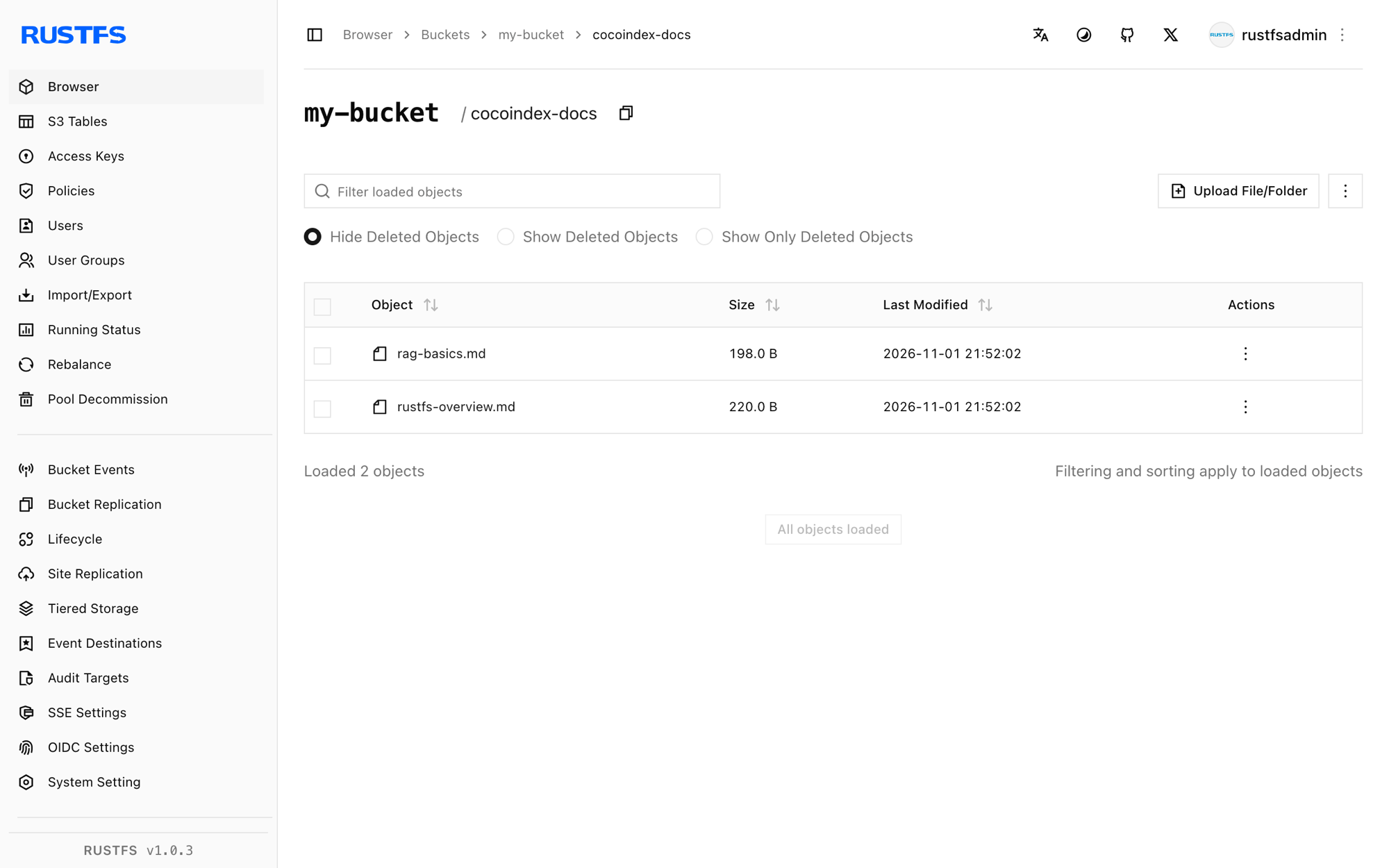
Upload source documents into a bucket prefix, replacing all connection placeholders:
aws s3 cp ./docs s3://my-bucket/cocoindex-docs/ --recursive \
--endpoint-url http://<your-rustfs-endpoint>:9000upload: docs/rag-basics.md to s3://my-bucket/cocoindex-docs/rag-basics.md
upload: docs/rustfs-overview.md to s3://my-bucket/cocoindex-docs/rustfs-overview.mdWrite the flow
Create the environment file and the flow. The S3 client is created with AWS_ENDPOINT_URL set, which aiobotocore honors for S3-compatible endpoints:
S3_BUCKET=my-bucket
S3_PREFIX=cocoindex-docs/
AWS_ENDPOINT_URL=http://<your-rustfs-endpoint>:9000
AWS_ACCESS_KEY_ID=<your-access-key>
AWS_SECRET_ACCESS_KEY=<your-secret-key>
AWS_DEFAULT_REGION=us-east-1
COCOINDEX_DB=postgres://cocoindex:cocoindex@localhost:5432/cocoindex
POSTGRES_URL=postgres://cocoindex:cocoindex@localhost:5432/cocoindeximport asyncio, os, sys
from dataclasses import dataclass
from typing import AsyncIterator, Annotated
import aiobotocore.session
import asyncpg
from dotenv import load_dotenv
from numpy.typing import NDArray
from pgvector.asyncpg import register_vector
load_dotenv()
import cocoindex as coco
from cocoindex.connectors import amazon_s3, postgres
from cocoindex.ops.sentence_transformers import SentenceTransformerEmbedder
from cocoindex.ops.text import RecursiveSplitter
from cocoindex.resources.chunk import Chunk
from cocoindex.resources.file import PatternFilePathMatcher
DATABASE_URL = os.environ["POSTGRES_URL"]
TABLE_NAME = "rustfs_doc_embeddings"
PG_SCHEMA_NAME = "coco_examples"
S3_BUCKET = os.environ["S3_BUCKET"]
S3_PREFIX = os.getenv("S3_PREFIX", "")
EMBED_MODEL = "sentence-transformers/all-MiniLM-L6-v2"
PG_DB = coco.ContextKey[asyncpg.Pool]("db")
S3_CLIENT = coco.ContextKey[object]("s3_client")
EMBEDDER = coco.ContextKey[SentenceTransformerEmbedder]("embedder", detect_change=True)
_splitter = RecursiveSplitter()
@coco.lifespan
async def coco_lifespan(builder: coco.EnvironmentBuilder) -> AsyncIterator[None]:
async with asyncpg.create_pool(DATABASE_URL, init=register_vector) as pool:
builder.provide(PG_DB, pool)
builder.provide(EMBEDDER, SentenceTransformerEmbedder(EMBED_MODEL))
session = aiobotocore.session.get_session()
async with session.create_client("s3") as s3_client:
builder.provide(S3_CLIENT, s3_client)
yield
@dataclass
class DocEmbedding:
id: int
filename: str
text: str
embedding: Annotated[NDArray, EMBEDDER]
@coco.fn
async def process_chunk(chunk: Chunk, filename: str, table: postgres.TableTarget[DocEmbedding]) -> None:
table.declare_row(row=DocEmbedding(
id=abs(hash(f"{filename}:{chunk.start.char_offset}")) % (10 ** 9),
filename=filename, text=chunk.text,
embedding=await coco.use_context(EMBEDDER).embed(chunk.text),
))
@coco.fn(memo=True)
async def process_file(file: amazon_s3.S3File, table: postgres.TableTarget[DocEmbedding]) -> None:
text = await file.read_text()
chunks = _splitter.split(text, chunk_size=2000, chunk_overlap=500, language="markdown")
await coco.map(process_chunk, chunks, file.file_path.path.as_posix(), table)
@coco.fn
async def app_main() -> None:
target_table = await postgres.mount_table_target(
PG_DB, table_name=TABLE_NAME,
table_schema=await postgres.TableSchema.from_class(DocEmbedding, primary_key=["id"]),
pg_schema_name=PG_SCHEMA_NAME,
)
client = coco.use_context(S3_CLIENT)
files = amazon_s3.list_objects(client, S3_BUCKET, prefix=S3_PREFIX,
path_matcher=PatternFilePathMatcher(included_patterns=["**/*.md"]))
await coco.mount_each(process_file, files.items(), target_table)
app = coco.App(coco.AppConfig(name="RustFSDocs"), app_main)
TOP_K = 5
async def query_once(
pool: asyncpg.Pool,
embedder: SentenceTransformerEmbedder,
query: str,
*,
top_k: int = TOP_K,
) -> None:
query_vec = await embedder.embed(query)
async with pool.acquire() as conn:
rows = await conn.fetch(
f"""
SELECT filename, text, embedding <=> $1 AS distance
FROM "{PG_SCHEMA_NAME}"."{TABLE_NAME}"
ORDER BY distance ASC
LIMIT $2
""",
query_vec,
top_k,
)
for r in rows:
score = 1.0 - float(r["distance"])
print(f"[{score:.3f}] {r['filename']}")
print(f" {r['text']}")
print("---")
async def query(initial_query: str | None = None) -> None:
embedder = SentenceTransformerEmbedder(EMBED_MODEL)
async with asyncpg.create_pool(DATABASE_URL, init=register_vector) as pool:
if initial_query is not None:
await query_once(pool, embedder, initial_query)
return
while True:
q = input("Enter search query (or Enter to quit): ").strip()
if not q:
break
await query_once(pool, embedder, q)
if __name__ == "__main__":
initial = " ".join(sys.argv[1:]) if len(sys.argv) > 1 else None
asyncio.run(query(initial))Build the index from RustFS
set -a && . ./.env && set +a
./.venv/bin/cocoindex update main✅ app_main: 1 total | 1 added
✅ process_file: 2 total | 2 addedBoth markdown files were read from the RustFS bucket, split, and embedded into Postgres. Query the index with the entrypoint in main.py. It loads .env, embeds the question with the same model, and prints the nearest chunks:
./.venv/bin/python main.py "what does RustFS expose"[0.163] rag-basics.md
Retrieval augmented generation combines a retriever and a generator.
---The query hits chunks whose source of truth is the bucket — edit a file in RustFS and re-run cocoindex update main to incrementally re-index only the change.
Stop or reset
To delete the indexed documents:
aws s3 rm s3://my-bucket/cocoindex-docs --recursive \
  --endpoint-url http://<your-rustfs-endpoint>:9000
Troubleshooting
Environment settings must provide Settings.db_path
CocoIndex keeps its own state in Postgres. Set COCOINDEX_DB (and POSTGRES_URL for the target) to a database with the pgvector extension enabled.
InvalidAccessKeyId or connection timeouts from the flow
The environment variables were not exported before running the flow (set -a && . ./.env && set +a). The AWS_ENDPOINT_URL must include the scheme; credentials go through the standard AWS_ACCESS_KEY_ID/AWS_SECRET_ACCESS_KEY pair.
The flow sees no files
Check the prefix and matcher — list_objects walks S3_PREFIX and filters by included_patterns. Confirm the objects exist with aws s3 ls s3://my-bucket/cocoindex-docs/.
Next steps
- Review S3 compatibility notes before wiring additional sources on the same bucket.
- Create dedicated production credentials with Access Key Management.
- Follow the CocoIndex Amazon S3 connector documentation for path matchers, size limits, and live updates.