
Apache Pulsar
Offload cold Pulsar topic backlog from BookKeeper into a RustFS bucket with tiered storage.
This guide connects Apache Pulsar to RustFS through its tiered-storage S3 offloader. You will run a standalone broker with offloading pointed at a RustFS bucket, produce messages, trigger a ledger offload, and read the offloaded messages back from the bucket. The workflow was verified with apachepulsar/pulsar-all:4.0.4 offloading a topic to RustFS and serving cold reads from it.
You need Docker. This deployment is intended for local integration testing, not production.
Architecture
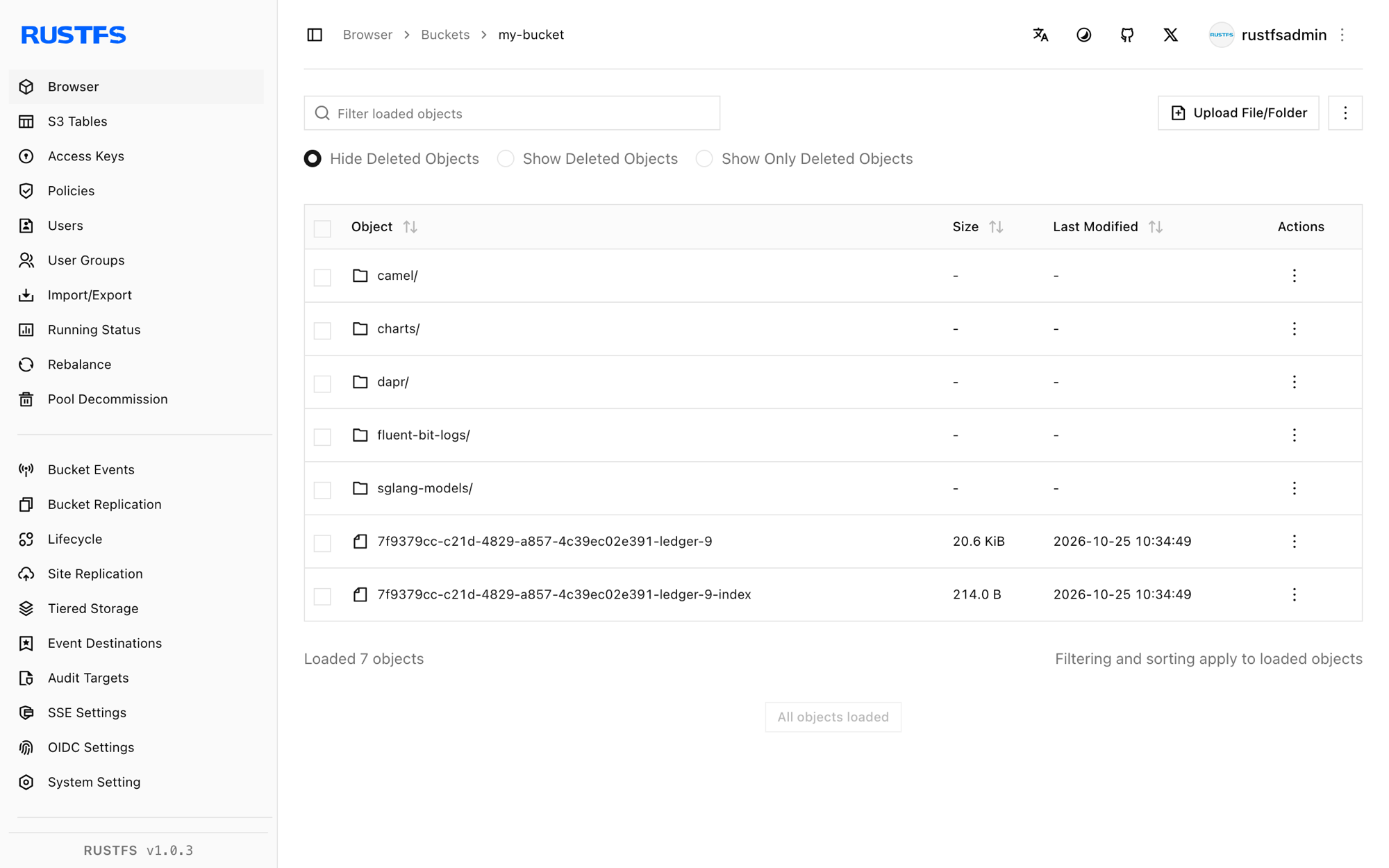
Old ledgers are uploaded to the bucket as <offloader-id>-ledger-<n> data blocks plus a small -index object, and the broker reads them back transparently when a consumer asks for messages that are no longer in BookKeeper.
Start the standalone broker with offloading
The plain apachepulsar/pulsar image ships without offloader packages and fails with No offloader found for driver 'S3' — use the pulsar-all image, which includes them. The broker is capped to a small heap:
docker run -d --name pulsar -p 6650:6650 -p 8080:8080 \
  -e ACCESS_KEY_ID=<your-access-key> \
  -e ACCESS_KEY_SECRET=<your-secret-key> \
  -e PULSAR_MEM="-Xms512m -Xmx512m" \
  --entrypoint bash apachepulsar/pulsar-all:4.0.4 -c '
    sed -i -e "s|^managedLedgerMaxEntriesPerLedger=.*|managedLedgerMaxEntriesPerLedger=100|" \
           -e "s|^managedLedgerMinLedgerRolloverTimeMinutes=.*|managedLedgerMinLedgerRolloverTimeMinutes=1|" \
           /pulsar/conf/standalone.conf
    printf "\nmanagedLedgerOffloadDriver=S3\nmanagedLedgerOffloadBucket=my-bucket\nmanagedLedgerOffloadServiceEndpoint=http://<your-rustfs-endpoint>:9000\nmanagedLedgerOffloadRegion=us-east-1\n" >> /pulsar/conf/standalone.conf
    exec bin/pulsar standalone -nss
  '
The two managedLedger* edits shrink ledgers so a rollover happens within the demo; the appended block enables offloading.
Driver S3 reads managedLedgerOffload* keys, not s3ManagedLedgerOffload*
For driver S3 the offloader resolves the generic managedLedgerOffloadBucket, managedLedgerOffloadServiceEndpoint, and managedLedgerOffloadRegion keys. The s3ManagedLedgerOffload* names belong to the aws-s3 driver and are ignored here — with them, the offloader crashes with NullPointerException: endpoint. The same applies to credentials: driver S3 reads ACCESS_KEY_ID and ACCESS_KEY_SECRET environment variables, not the AWS_* pair.
Wait for the broker:
docker logs -f pulsar 2>&1 | grep -m1 "The ledger offloader was created"Produce messages and keep the topic alive
Topics with no subscription are deleted by the inactive-topic cleanup within minutes, which cancels the demo mid-flight. Produce a first batch, then create a durable subscription that keeps the topic registered:
docker exec pulsar bin/pulsar-client produce -m "hello rustfs offload" -n 300 \
persistent://public/default/rustfs-test300 messages successfully producedtimeout 30 docker exec pulsar bin/pulsar-client consume -s keepalive -n 1 -p Earliest \
persistent://public/default/rustfs-testRoll a ledger and trigger the offload
A ledger only rolls when a write happens after managedLedgerMinLedgerRolloverTimeMinutes has passed — the check runs on write, not in the background. Wait at least one minute, produce another batch to force the roll, then offload everything older than the last kilobyte:
sleep 65
docker exec pulsar bin/pulsar-client produce -m "rollover" -n 120 \
  persistent://public/default/rustfs-test
docker exec pulsar bin/pulsar-admin topics offload -s 1K \
persistent://public/default/rustfs-testOffload triggered for persistent://public/default/rustfs-test for messages before 11:0:-1The offload takes a moment — wait for completion:
sleep 30
docker exec pulsar bin/pulsar-admin topics offload-status \
persistent://public/default/rustfs-testOffload was a successConfirm the ledger objects landed in RustFS — data block plus index, at the bucket root:
aws s3 ls s3://my-bucket/ --recursive \
--endpoint-url http://<your-rustfs-endpoint>:9000 | grep ledger2026-10-25 02:34:49 21057 7f9379cc-c21d-4829-a857-4c39ec02e391-ledger-9
2026-10-25 02:34:49 214 7f9379cc-c21d-4829-a857-4c39ec02e391-ledger-9-indexRead the offloaded messages back
Consume from the earliest position with a fresh subscription. The first ledger now lives only in RustFS, so every message the broker returns is a cold read from the bucket:
timeout 90 docker exec pulsar bin/pulsar-client consume -s coldread -n 420 -p Earliest \
persistent://public/default/rustfs-test 2>&1 | grep -c "^-----"420All 420 messages — the 300 from the offloaded ledger plus the 120 from the active one — come back through the bucket.
Stop or reset
To tear down the broker while keeping the bucket objects:
docker rm -f pulsarTo delete the offloaded ledgers:
aws s3 rm s3://my-bucket/ --recursive --exclude "*" --include "*ledger*" \
  --endpoint-url http://<your-rustfs-endpoint>:9000
Troubleshooting
No offloader found for driver 'S3'. Please make sure you dropped the offloader nar packages
The image does not include the offloader NARs. Use apachepulsar/pulsar-all as shown in step 1.
NullPointerException: endpoint when offloading
The offloader read no service endpoint — the managedLedgerOffload* keys are missing or were written with the s3ManagedLedgerOffload* names of the aws-s3 driver. Append the exact block from step 1 and restart.
Couldn't get the access key id. in the broker log
Driver S3 does not read AWS_ACCESS_KEY_ID. Export ACCESS_KEY_ID and ACCESS_KEY_SECRET on the broker container.
Topic ... not found during the demo
The inactive-topic cleanup deleted the topic because it had no subscription. Re-run step 2 and keep the keepalive subscription in place.
Offload was a success but no objects appear
Only closed ledgers older than the size threshold are uploaded, and a ledger rolls on the next write after the minimum rollover age. Produce another batch, then trigger the offload again.
Next steps
- Review S3 compatibility notes before enabling automatic offload thresholds on namespaces.
- Create dedicated production credentials with Access Key Management.
- Follow the Pulsar tiered storage documentation for namespace thresholds, retention policies, and multi-node brokers against the same bucket.